Integrated Training Program in Data Science and Exposomics for ADRD and Aging Research (T32AG102367)
AGing/ADRD, ExposomIcs and data Sciences (AGEIS)
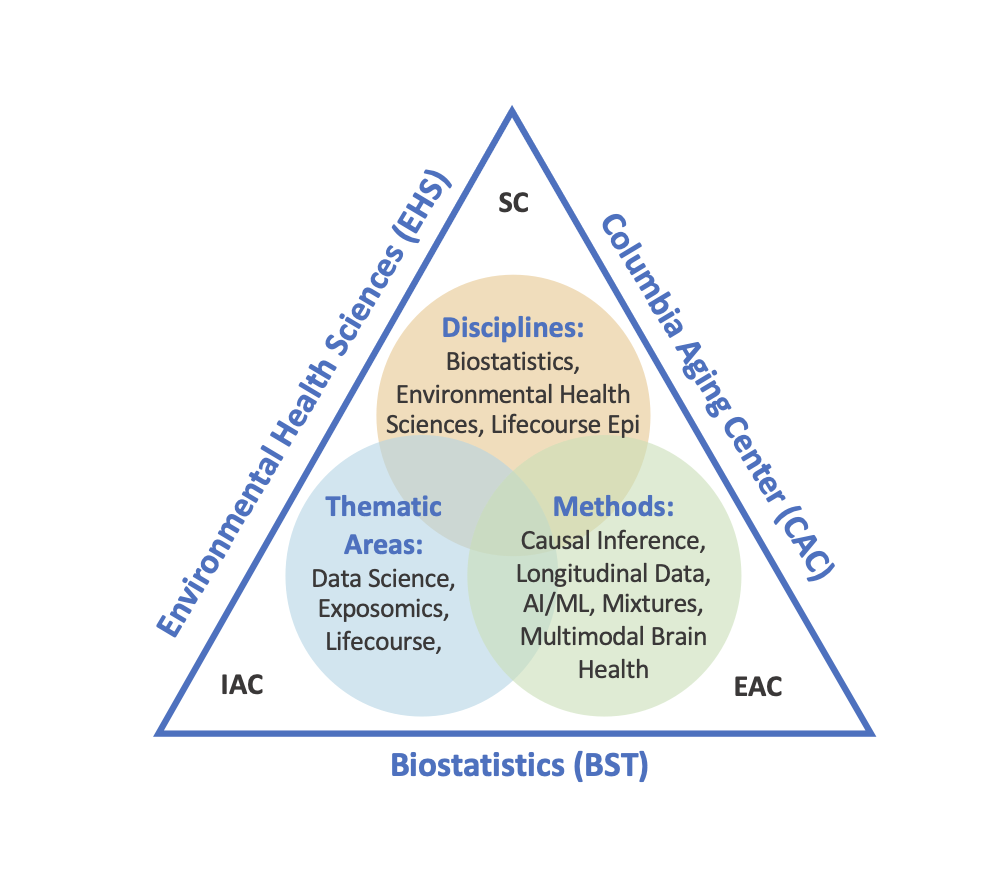
The Columbia University AGing/ADRD, ExposomIcs and data Sciences (AGEIS) training program will produce world-class interdisciplinary scientists through a program integrating efforts across the Departments of Biostatistics (BST) and Environmental Health Sciences (EHS) and the Robert N Butler Columbia Aging Center (CAC), in collaboration with other departments and institutes across Columbia University, including Epidemiology, Neurology, and Medicine. Pre- and Post-doctoral trainees will receive integrated training in biostatistics, environmental health sciences, and the lifecourse development of Alzheimer’s Disease and Related Disorders (ADRD) risk. AGEIS will leverage strong existing curricula augmented by additional activities developed specifically for this training grant including an annual symposium, integrative journal club, monthly convenings, and practical activities (e.g., clinic visits, technical presentations on omics assays, environmental monitoring approaches, brain scans, neuropsychological testing, and biobank management, with trainees completing as many as 3 rotations per year). Trainees will be mentored by cross-disciplinary teams of faculty, ensuring a robust interdisciplinary educational experience that will drive future discoveries in lifecourse ADRD prevention. While trainees will specialize in disciplinary tracks—such as biostatistics, exposomics, and lifecourse epidemiology, they will also receive joint training and will collaborate during coursework and our integrative educational activities. For our training program, we request trainee slots to fund predoctoral (3 in Year 1 and six in all subsequent years) and postdoctoral trainees (3 per year), who will be funded for a target of up to 2 years. Students will be recruited into one of the three program units—BST, EHS and CAC (evenly distributed across units)—and will collaborate during coursework and our integrative educational activities, and through research rotations across the three units. All trainees will have mentors from at least two units, one of which will be CAC. Our trainees will 1) develop core competencies and skills in biostatistics, environmental health sciences, and lifecourse development of ADRD risk, to be able to conduct high-impact research, 2) gain foundational knowledge in cross-cutting research skills through mentorship from experts and attendance at short courses and seminars in complementary fields, and 3) cultivate leadership skills, collaborative research, and team science. In all activities, Postdoctoral trainees will have the opportunity to co-mentor predoctoral trainees. Through this program, we will equip the next generation of scientific leaders in ADRD research with skills and integrative vision to work across disciplinary boundaries and harness the potential of emerging big-data resources and AI tools to map the exposome across the lifecourse and identify modifiable causes and pathways to prevention of ADRD.
Postdoctoral Training Program
Reporting to Associate Professor Daniel Belsky, the Postdoctoral Research Scientist develops and leads projects related to and working in close collaboration with Belsky’s program of research into (1) development of omics-based aging biomarkers (we specialize in molecular speedometers to measure Pace of Aging); (2) omics analysis of clinical trials to determine impact on aging biology; (3) omics analysis of social policy trials to investigate impacts on aging biology; (4) life course epidemiology of aging. Specifically, the postdoctoral scholar will apply for mentored and independent research funding to support research on biological aging; they will lead preparation of scholarly manuscripts reporting research from these new projects and projects ongoing within Belsky’s group; and they will contribute as a collaborator on other ongoing projects.
Interested applicants should email their CV and personal statement to Daniel Belsky (db3275@cumc.columbia.edu) and Kiros Berhane (ktb2132@cumc.columbia.edu). We are currently recruiting postdoctoral fellows to begin in early 2027.